



DIABETIC FOOT
Part One
Diabetes accelerates the blockage, that is, arteriosclerosis of the blood vessels in the brain, eyes, heart, kidneys, and legs. Patients with type 1 diabetes (younger, on insulin) more often have damage to the small blood vessels (microangiopathy) in the eyes and kidneys. Those suffering from type 2 diabetes (older – most often using tablets) more often have damage to the larger blood vessels (macroangiopathy) in the brain, heart, and legs.
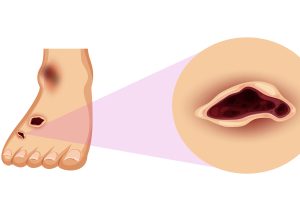
The nerves are the most sensitive to lack of blood in the legs, which is why the disease begins with symptoms of tingling, burning, and pain in the feet and legs. The symptoms are most pronounced when the patient is at rest, that is, during relaxation and before sleep. This is called diabetic neuropathy. When the foot becomes pale and the toes cold, the blood flow in the blood vessels is also reduced, and this condition is described as diabetic angiopathy.
In the majority of patients, the clinical picture is usually mixed, meaning tingling, prickling, and pain are present together with cold toes and pale feet, and the medical term used is Angioneuropathia diabetica. The symptoms are most pronounced in the toes and the foot, and this condition is also called the “diabetic foot syndrome.”
So, diabetic foot represents damage to the arteries and nerves of the toes and the foot, caused by high blood sugar values. When the narrowing of the blood vessels progresses along the lower leg, and especially the thigh, pain during walking appears, called claudication. Claudication pain occurs if more than 50% of the diameter of the blood vessel is narrowed. Up to this narrowing, the body compensates for the problems with blood flow by engaging nearby small-caliber blood vessels, called collaterals, and because of this, the patient practically has no symptoms.
In prevention, the most important thing is early detection of narrowing of blood vessels that is less than 50%, because with timely treatment in this stage, the disease can be controlled long-term, that is, its progression toward clinical symptoms and gangrene can be prevented.
This is done with vascular Doppler sonography. This is a standard ultrasound examination recommended to be performed once a year in all patients with diabetes. This technique is recommended by the world, European, and American associations for the control and treatment of diabetes. Early detection and proper treatment of diabetic foot protects against disease progression and its most severe complications, which are gangrene and amputation of the legs.
Conservative treatment consists of controlling risk factors, primarily regulating blood sugar, fats, and blood pressure, as well as using medications that reduce platelet stickiness and fat on the blood vessel wall. These drugs are called antiaggregants, and their most well-known representative is Aspirin.
In patients who have tingling, prickling, and burning in the legs (neuropathy), it is also recommended to check the function of the nerves in the foot. This is done with the help of tests for fine touch assessment (10-gram monofilament), control of touch sensitivity with a needle (pin prick), and control of vibration sensitivity (biothesiometer).
Clinical studies conducted by the most renowned diabetic institutions have established that these annual systematic examinations of the blood vessels in diabetic patients reduce the number of leg amputations by 50% in the next 10 years.
This is a standard preventive procedure for diabetic patients, applied by private health insurance companies, especially in Western Europe and the USA. If the patient does not undergo testing in the recommended period, insurance does not cover the costs for treatment of complications, primarily the treatment of open wounds and gangrene of the legs.
Their recommendation is:
Patients with diabetes,
Invest in the health of your feet. Regularly check the condition of your blood vessels and nerves in your legs, which will protect you from possible complications (gangrene) that lead to disability.

This informational material is part of the care that the Clinic “Srce” provides for its patients with diabetes.
The material was prepared by Prof. Dr. Slavcho Toshev – cardioangiologist.
